
- About Us
Who are we
What are we doing
Our Impact
- Support us
- About Us
Who are we
What are we doing
Our Impact
- Support us

- About Us
Who are we
What are we doing
Our Impact
- Support us
Environment and Climate Action
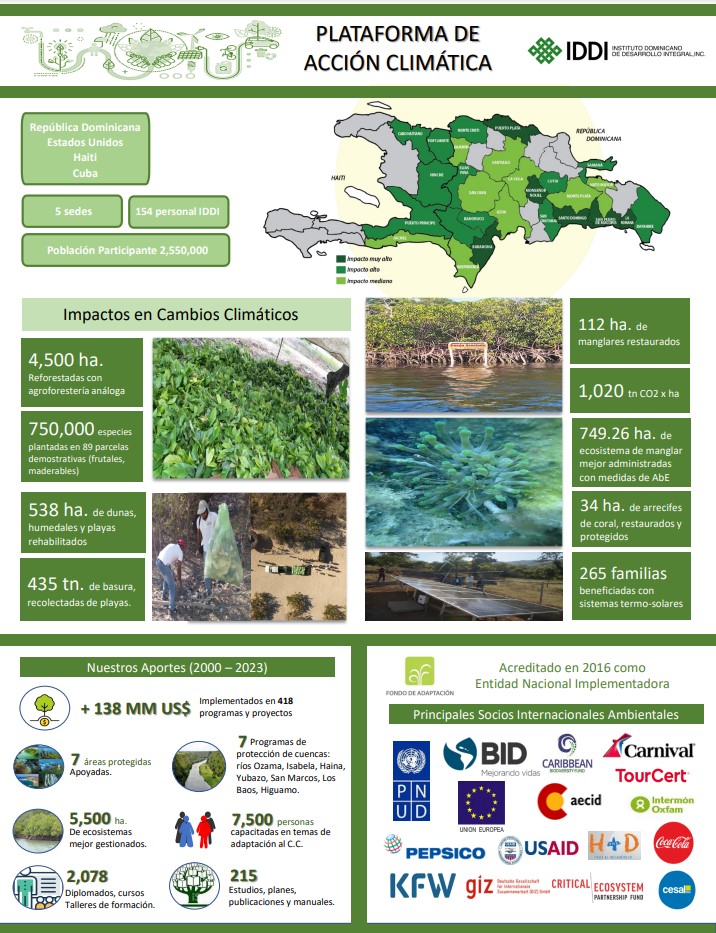
IDDI Climate Action Platform
The Dominican Republic, as a Small Island Developing State (SIDS), is exposed to various recurrent threats, most of which stem from climate events such as hurricanes, storms, floods, fires, droughts, and epidemics, in addition to seismic events like earthquakes and landslides. The Dominican Republic ranks 11th in the 2017 World Risk Index and is among the 10 nations most affected by these climatic phenomena between 1997 and 2016. This situation is exacerbated in cities due to internal and external migration, pressure on natural resources, population growth, and industrialization, which presents a particular challenge for climate risk management in urban contexts.
In this context, the adoption of the Paris Agreement in 2015 set the world on an ambitious and essential path toward resilient, carbon-free development.
The IDDI, through its Climate Action Platform and its Center for Climate Change and Sustainable Development (CCDS), founded in 2011, aligns with the Paris Agreement and the Dominican Republic's commitment through its Nationally Determined Contribution (NDC-RD), as the National Implementing Entity (NIE) of the Adaptation Fund, and pursues the following objectives:
Educate and disseminate knowledge on Climate Change, Adaptation, and Mitigation.
Formulate and promote climate action projects and fund channeling with innovative approaches.
Strengthening the capacities of public, private, and civil society actors through the creation and promotion of entities such as the National Coalition of Resilient Cities (CNCR), which seeks municipal empowerment in climate action.
Impact on Public Policies (Climate Change Law and Solid Waste Law).
Technological Innovation for Climate Change Adaptation and Mitigation (currently coastal-marine environments).
Promote research.
Strengthen climate transparency mechanisms.
Impact on Public Policies (Climate Change Law and Solid Waste Law).
Technological Innovation for Climate Change Adaptation and Mitigation (currently coastal-marine environments).
Promote research.
Strengthen climate transparency mechanisms.
In its 2020 NDC, the Dominican Republic has raised its climate ambition by committing to a 27 % reduction in GHG emissions compared to the business-as-usual (BAU) scenario by 2030. The report presents 46 mitigation options, broken down as follows: (i) 27 options identified and evaluated for the Energy sector (focused on electricity generation, energy efficiency, and road transportation), 4 options identified and evaluated for the Industrial Products and Processes (IPPU) sector, 10 options identified for the Agriculture, Forestry, and Other Land Use (AFOLU) sectors, and 5 for the Waste sector. Based on the evaluated and proposed mitigation options, the country aims to reduce emissions by 13,853.71 Gg CO2eq, representing a 27.16 % compared to the 2030 BAU scenario estimated at 51,000 Gg CO2eq, with an estimated required investment of USD $ 8,916,950,000.00, expressed in both conditional and unconditional terms.
However, the Dominican Republic, due to its status as a Small Island Developing State (SIDS), focuses its climate action primarily on Adaptation, which refers to the adjustments in ecological, social, or economic systems that must be made in response to current and anticipated climate changes and their effects. It centers on changes in processes, practices, and structures to reduce potential damages or to take advantage of opportunities associated with climate change. Some of these impacts, such as droughts, floods, cyclones, sea-level rise, or extreme temperatures, exert strong pressures on the socioeconomic development of society.
Due to the expected changes in the frequency, magnitude, and duration of adverse climate phenomena, IDDI's focus is on the sustainable development of sectors that, like agriculture, forest resources, water resources, food security, coastal-marine resources, tourism, health, the environment, and livelihoods, are highly sensitive to climate change and variability, in order to increase their resilience.
Adaptation solutions take many forms and modalities, depending on the unique context of a community, company, organization, country, or region. There is no one-size-fits-all solution. Therefore, IDDI, as a neutral actor, focuses on mobilizing stakeholders and channeling funds for climate risk management through policies and institutional and regulatory frameworks, strengthening local and national capacities, and developing instruments such as climate vulnerability and risk assessments, financing mechanisms, and climate insurance, and identifying measures and approaches such as:
Integrated water resource management
Urban resilience
Ecosystem-based Adaptation
Climate-Smart Agriculture
Sustainable Tourism
Integrated Solid Waste Management
Energy
Transportation and mobility
Climate Finance and Insurance
Climate Transparency
CC-resilient infrastructure
Technological Innovation for Climate Change

The IDDI is working hard to contribute to the transformation of human beings, their families, and the community in which we live.
Faced with a common problem, we are all the solution.