
- About Us
Who are we
What are we doing
Our Impact
- Support us
- About Us
Who are we
What are we doing
Our Impact
- Support us

- About Us
Who are we
What are we doing
Our Impact
- Support us
Departments
Physical Works
Agreement on Access to Potable Water, Integral Environmental Sanitation, and Improvement of Health Conditions in the Southwest Region of the Dominican Republic and Southwest of Haiti and in Peri-urban Neighborhoods of Santo Domingo.
What is the program about?
The IDDI understands that one of the most pressing problems affecting low-income populations in both the Dominican Republic and Haiti is the lack of access to clean water. Many diseases are preventable simply by the supply of clean water.
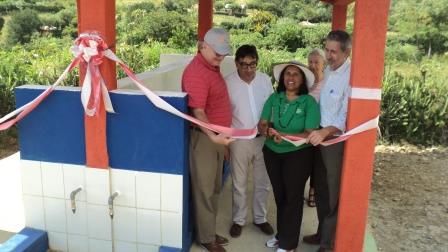
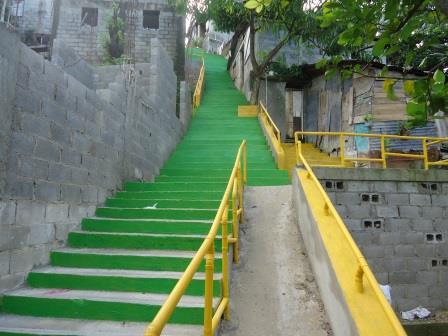
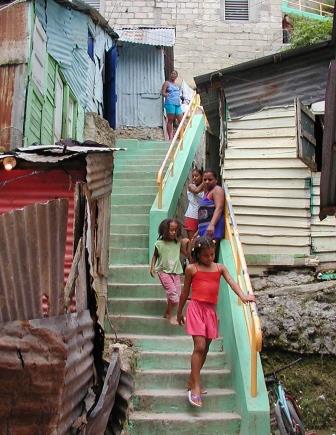
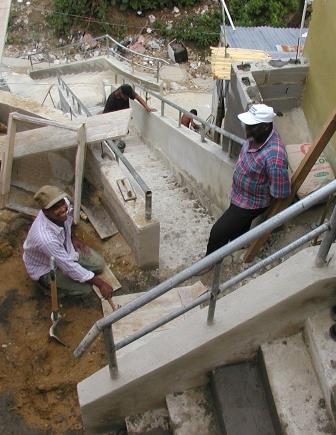
As a result, for many years, IDDI has carried out a water and environmental sanitation campaign in multiple communities, including the construction of aqueducts to increase the coverage of effective and sustainable drinking water and sanitation services in rural communities, improving access to water. It also includes improving sanitation through the installation of community micro-sanitation systems, environmental sanitation improvement infrastructure projects (pedestrian crossings, clearing and cleaning of ravines), management of urban solid waste through the creation and strengthening of community solid waste collection businesses, and education and awareness of the population on water issues.
Participant population
450 families
from the communities of: La Lomita, Lucazada, Roncador, El Duan, Pinzon, and Juan Felipe.
600 families
from the communities of: Les Cacaos, El Corte, Catalina, and Carabonite.
850 children
from the communities of: Les Cacaos, Catalina, and Carabonite.
12,770 people
From the neighborhoods: El Café, La Mina, Hermanas Mirabal, Duarte, Enriquillo, and Las Palmas.
Funding Sources


“Improvement of sanitary and environmental conditions in the communities: La Caoba and Cumajón, Villa Hermosa Municipality, La Romana Province”
Contribute to improving living conditions and environmental quality in vulnerable communities in the municipality of Villa Hermosa through access to drinking water and basic sanitation.
Specific objectives
Ensure access to drinking water in communities by improving and expanding the water network.
Expand and improve the community-level wastewater collection system and provide sanitary modules to families, in order to reduce pollution and the incidence of diseases.
Develop a health education and awareness campaign on water use, waste management, and pollution reduction.
Promote community participation and empowerment to ensure the management and maintenance of the works.
To contribute to the construction of a community waste collection system, as well as recycling-related activities for the improvement of environmental quality.
Study Population
800 direct family members
1,200 families indirectly
Interventions
Construction of 1,500 linear meters of pipe to bring drinking water to families and 100 household connections.
Construction of 5 septic tanks for the discharge and treatment of restrooms.
The construction of 50 sanitary modules, which will benefit the most vulnerable families who do not have them in their homes.
They conduct 1500 family visits and educational talks, bringing important information to families on topics of health, hygiene, and prevention of diseases like dengue and cholera.
Carrying out community sanitation days in the most sensitive areas such as ravines, drains, streets, and common areas, to reduce contamination and flood risks.
Creation of community networks for the monitoring and management of public service provision, such as drinking water, infrastructure maintenance, solid waste management, as well as a team of forty (40) promoters responsible for providing follow-up and guidance to the families benefiting from the project.
Extensive awareness-raising, training, and education for the populace, along with the strengthening of their grassroots organizations.
Funding Sources
Dominican Institute for Integral Development
Tabacalera de García
Mayor's Office of the Municipality of Villa Hermosa
Cumajón and Las Caobas Schools Address.
Altadis Foundation
Neighborhood associations and churches.
Corporation of Aqueducts and Sewers of La Romana, COAAROM
General Directorate of Health.







The IDDI is working hard to contribute to the transformation of human beings, their families, and the community in which we live.
Faced with a common problem, we are all the solution.